The Model
A small village of homes, around a common heart.
1000 Villagers is a planned neighborhood where some adults with developmental disabilities and some aging parents may choose to live nearby. Each adult chooses their own setting. Parents who want to stay close may live next door. Homes gather around an optional Commons on a rural site that is walkable, sensory-considered, and open to its surrounding hamlet.
The site
We are flexible on the site. A working pilot could begin in Earlville, NY, and the community can grow across one or more nearby sites as families join. We are deliberately starting small.
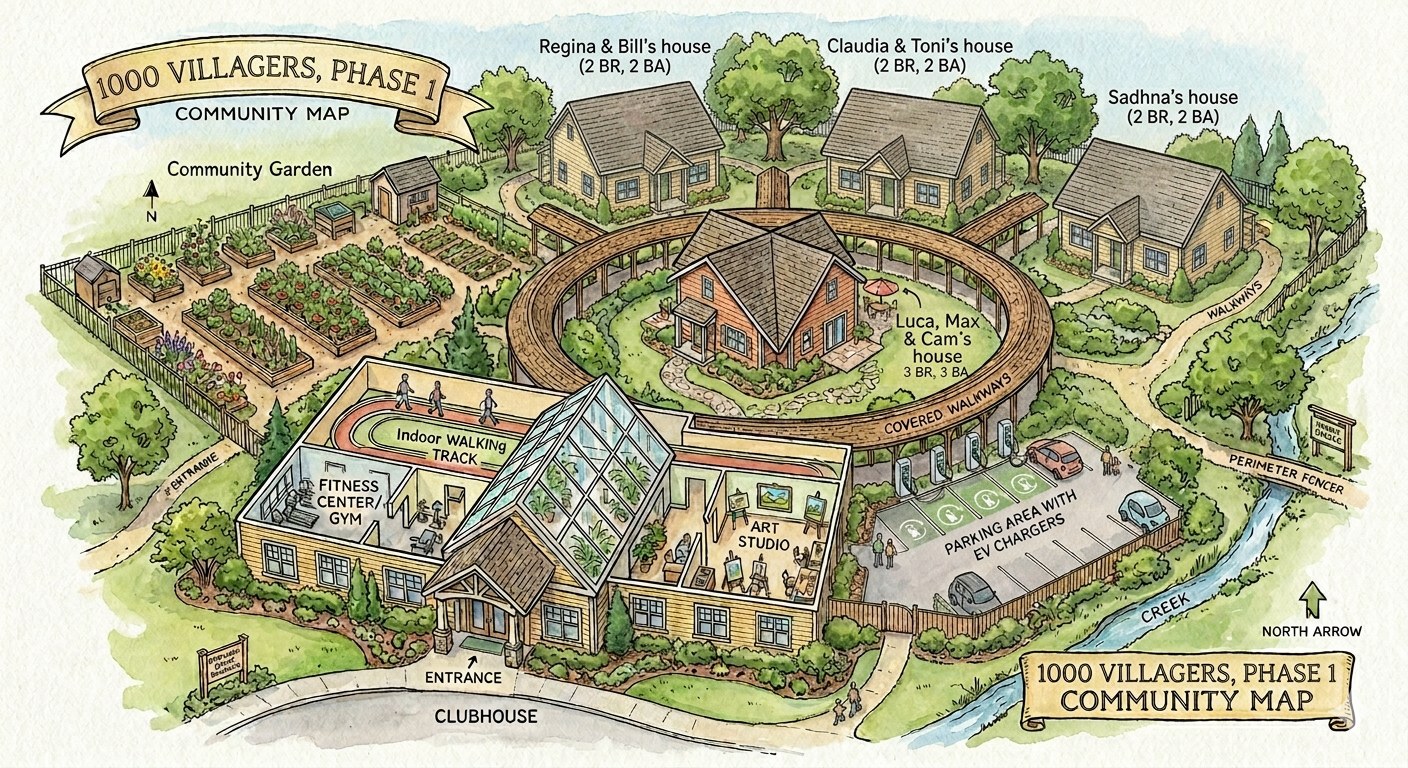
Sample dimensions
We are still working with our architects, but our reference range, drawn from peer communities like SpeciallyAble, is:
- Parent home: approximately 1,500 to 2,200 sq ft. One or two bedrooms, full kitchen, living, accessible bath, designed for aging in place.
- Adult home (if chosen): approximately 1,400 to 1,800 sq ft. Private suites, a common living room and kitchen, a quiet space, and an accessible bath. Sharing a house is optional; each adult (or their legally authorized representative) decides.
- Lot: approximately 6,000 to 7,500 sq ft per home site, with gardens between the homes.
The Commons
At the center of the village is the Commons, optional community space at domestic scale: a shared dining and gathering room, quiet spaces, and room for neighbors to meet. It is not housing for medical or therapeutic services, and it is not offices for village program staff. Medical care and therapy are chosen by the person in the broader community.
What surrounds the homes
- Walkable paths. Every home connects to the Commons by a footpath. The village is small enough that no one needs a vehicle to participate.
- Gardens and an orchard. Working land, vegetables, herbs, fruit trees, where residents who want to participate can.
- A pond and woods. The site is shaped by its natural features rather than carved against them.
- A single entry drive. Visible from the road. Not gated. Open to the wider community.
Out in the community
The village is a home base, not a world unto itself. Residents are out in the surrounding community as a matter of routine: the library, the parks, local shops and errands, museums and events, and the everyday life of the hamlet around us. Each adult chooses their own activities and providers, keeps their own schedule, and holds their own residency agreement, with real privacy and control over their own home and daily life. The point of living here is not to withdraw from the community; it is to take part in it, with the support to do that well.
If adults choose to share a home, they work out how to live in it together. The circle of support is chosen by the individual, except where law confers authority (14 NYCRR 636-1.2). Village preferences do not condition an adult's housing or HCBS. We say more in the FAQ.
How we grow
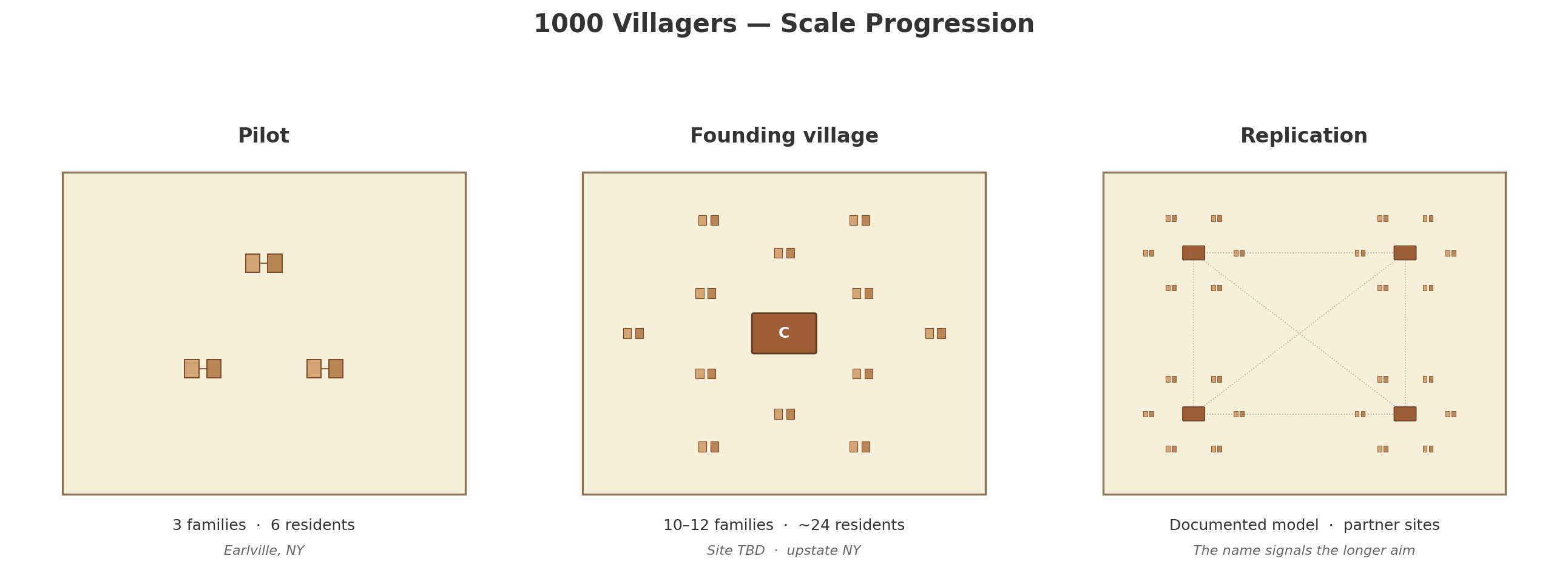
We will not arrive at the full vision overnight. We are planning in three stages, a small pilot, a founding village, and replication.
How it works financially
A guiding rule: the funding follows the person, not the building. Medicaid HCBS pays for services, never room and board. Public dollars pay only for the adult's own authorized services. Rent is SSI, family, or a special needs trust, and a housing subsidy only if separately awarded. Housing should be held so the adult (or an SNT or family) leases or owns, without a service provider owning, leasing, managing, or having a financial relationship with the landlord (14 NYCRR 636-2.3(j)). A service organization, if any, is separate and does not run the houses. Affordable-housing tax credits and public housing programs are an aspiration only; a disability-only campus can fail HCBS integration and housing-program rules, and settings that isolate can face heightened scrutiny (14 NYCRR 636-2.3(b)(3), (i); 79 Fed. Reg. 2948). The full picture lives on its own page.
What we are not
We are not a group home, a nursing facility, or a typical co-housing development. This project intends to comply with person-centered planning (14 NYCRR 636-1.2) and HCBS settings rules (14 NYCRR 636-2 / 42 CFR 441.301(c)(4)-(5)). It is not an OPWDD-operated or certified residence unless and until it holds an operating certificate. Moving here is not an OPWDD placement. Each adult chooses their setting and can leave for another one. OPWDD and the CCO authorize services, not the village.
For a clearer picture of why we chose this combination, read our guiding principles.